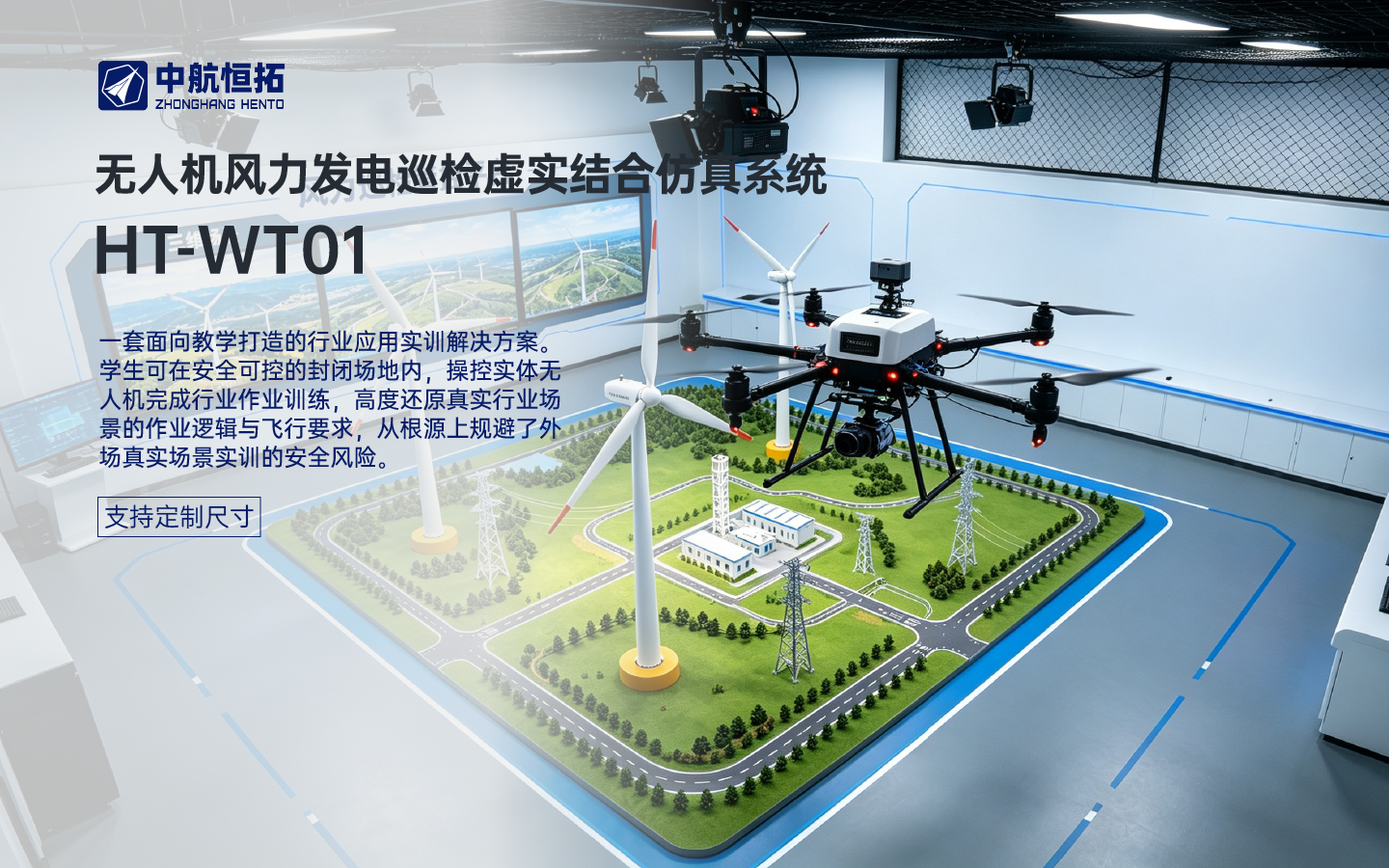
- This system is a comprehensive software-hardware integrated platform for inspection training of wind power plants. Deployable in an 8m×5m indoor space, it is specially designed for wind power inspection simulation training and intelligent recognition algorithm verification in GPS-denied indoor environments. The system consists of three modules: small wind inspection UAVs, wind inspection control and management platform, and wind power simulation scenario. The small wind inspection UAV is fitted with LiDAR, optical flow positioning, a domestic onboard computer, a three-axis gimbal stabilizer, and an ultra-high-definition visible-light/infrared thermal imaging dual-sensor camera, to perform wind power inspection flights and data acquisition. The wind inspection control and management platform adopts B/S (Browser/Server) architecture with on-premises deployment, enabling 3D scenario display, real-time flight monitoring, mission management and AI defect recognition algorithm deployment. The wind power simulation scenario includes wind turbines (comprising blades, hub, nacelle, tower and foundation), a step-up substation and outgoing transmission lines, replicating the real inspection operation environment of wind power plants.
- Equipped with a LiDAR sensing module and an optical flow positioning module, the system achieves high-precision positioning, spatial modeling and real-time obstacle avoidance in GPS-denied indoor environments. It can accurately identify the spatial positions and structural details of key components such as wind turbine blades, hub, nacelle, tower and foundation, and underpin algorithm verification and training for UAV autonomous navigation, flight path planning, AI defect recognition and other applications.
- The system platform supports 3D scenario display (with import of 3D scenario models of wind power plants), display of planned flight paths and real-time UAV trajectories, access to real-time visible/infrared video streams, and presentation of recognition results. It also enables real-time monitoring of UAV telemetry data (position, motion status, battery level, mission status), inspection mission management (flight path planning, mission scheduling, data management), and remote command control (takeoff/pause/continue/return/landing).
- The system supports synchronous acquisition of visible-light and infrared thermal imaging dual-sensor images and AI defect recognition. It can identify common defects including wind turbine blade damage (cracks, fractures, abrasion, lightning strike marks), missing hub bolts, nacelle surface damage, tower corrosion and coating peeling, and foundation settlement. Inspection data can be automatically recognized and annotated by the configured recognition algorithms, meeting the training demands of artificial intelligence courses such as wind power plant defect recognition and component identification.
- The system supports simulation of the impact of different wind speed and wind direction conditions on UAV inspection flight stability, with adjustable wind force from calm to level 3. It can simulate the impact of set wind levels on UAV flight stability, replicating inspection operation scenarios in complex meteorological environments of real wind farms. The system forms a closed-loop integrated teaching mode of "scenario cognition – simulated flight – defect recognition". Students can repeatedly practice core skills such as flight path planning, dual-sensor data acquisition, defect annotation and inspection report generation in the simulation scenario, making it suitable for practical training of courses including UAV wind inspection technology and new energy operation & maintenance.