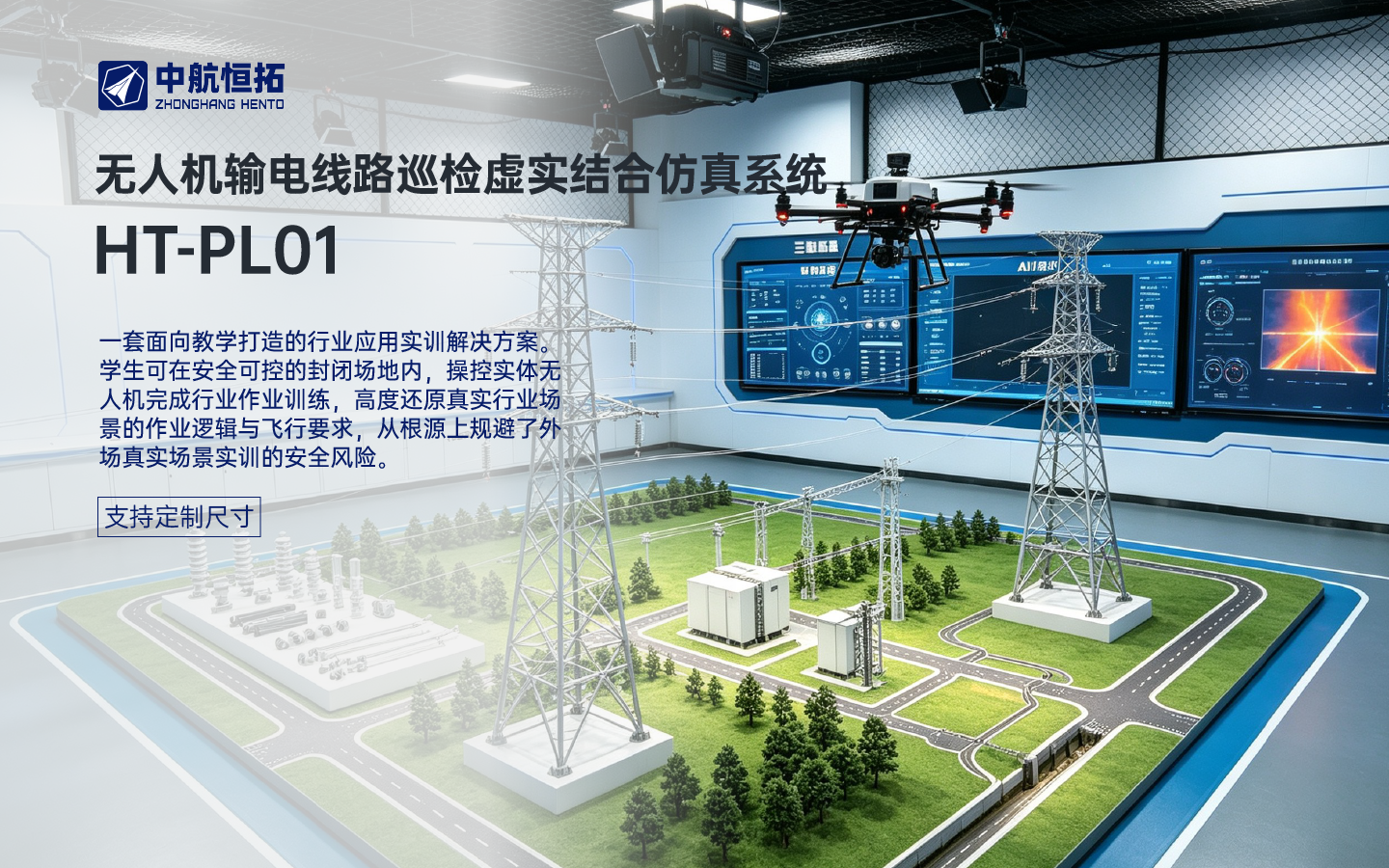
- This system is a comprehensive software-hardware integrated platform for simulation training of power transmission line inspection. Deployable in an 8m×5m indoor space, it is specially designed for inspection simulation training and intelligent recognition algorithm verification in GPS-denied indoor environments. The system consists of four modules: small indoor inspection UAVs, UAV control and management platform, power transmission line simulation scenario, and physical teaching aids of transmission line components. The small indoor inspection UAV is fitted with LiDAR, optical flow positioning, a domestic onboard computer and a three-axis gimbal stabilizer, to execute inspection flights and data acquisition. The UAV control and management platform adopts B/S (Browser/Server) architecture with on-premises deployment, enabling 3D scenario display, real-time flight monitoring, mission management and AI recognition algorithm deployment. The transmission line simulation scenario includes 1 suspension tower, 1 strain tower and complete transmission lines, replicating the real inspection operation environment. Different from fixed models in the simulation scenario, the physical teaching aids are full sets of real transmission line components (insulators, fittings, conductors, etc.), which are handheld and disassemblable for trainees to conduct close observation, tactile identification and structural cognition training.
- Equipped with a LiDAR sensing module and an optical flow positioning module, the system achieves high-precision positioning, spatial modeling and real-time obstacle avoidance in GPS-denied indoor environments. It can accurately locate the spatial positions of simulated components such as transmission towers, conductors, fittings and insulators, support data acquisition of 3D point clouds and Gaussian models, and underpin algorithm verification and training for UAV autonomous navigation, flight path planning, AI defect recognition and other applications.
- The system platform supports 3D scenario display (import of 3D Gaussian Splatting PLY and point cloud LAS models), display of planned flight paths and real-time UAV trajectories, real-time video stream access, and real-time recognition result presentation. It also enables real-time monitoring of UAV telemetry data (position, motion status, battery level, mission status), flight mission management (single/periodic/cyclic missions), and remote command control (takeoff/pause/continue/return/landing).
- The system supports configuration of diverse recognition algorithms and import of custom training models. Inspection data can be processed by the configured recognition algorithms, meeting the training demands of artificial intelligence courses such as transmission line defect recognition and component identification.
- The system is furnished with a full set of physical teaching aids of real transmission line components, including ceramic insulators, U-type clevises, ball-eyes, socket tongue plates, right-angle plates, parallel plates and aluminum conductor steel reinforced (ACSR). These are genuine components identical to those applied in on-site power grids, supporting trainees in close observation, tactile identification, disassembly & assembly practice and defect comparison learning. It forms a closed-loop integrated teaching mode of "physical cognition – simulated flight – intelligent recognition".